Arduino Serial Read File
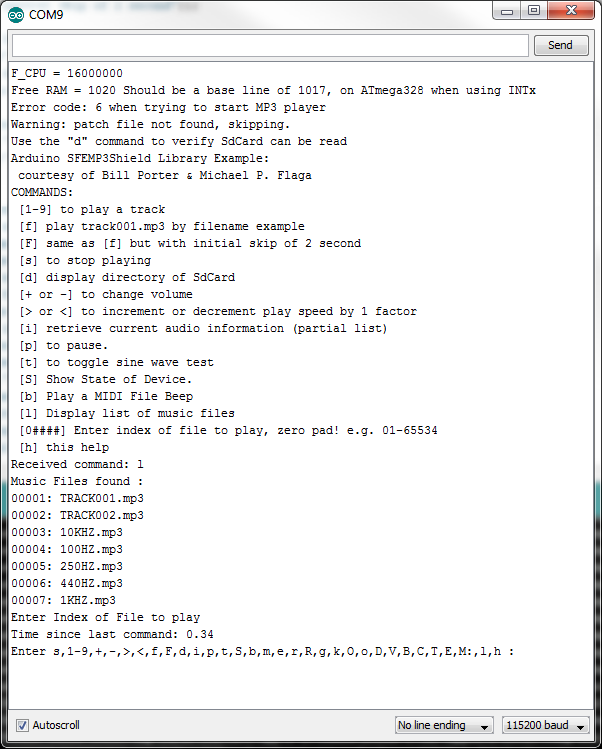
I am trying to read a text file 'Print1.txt', line by line, from an SD card attached to my Arduino MEGA. So far I have the following code: #include #include. Saving Arduino sensor data to a text file. On the processing side use a PrintWriter to write the data read from the serial port to a file. I'm trying to send data saved on a txt file to arduino over serial. Sending data from txt file over serial. Simultanous read and read/write on two serial. I am trying to read an ads1115 monitoring a current shunt so it's reading in millivolts. All I need is to be able to read the serial output from the arduino serial.
Introduction Spreadsheets are awesome! They are a ubiquitous and powerful file structure that can cause headache and joy in equally heart-stopping intensities.
Within the context of a larger project, you may want to save Arduino data (from sensors, for example) to a.csv file for further analysis, visualization, or whatever spreadsheet bonanzas you can dream up. The following two sketches save data from Arduino to a.csv file on your computer, complete with a timestamp with gloriously specific column names (year, month, day, hour, minute, secondand you can add milliseconds!).
This 2-sketch solution takes advantage of the built-in Table class in Processing. Tables are also awesome, as they are basically spreadsheets in the Processing world. Read all about them (this link has some handy methods for working with tables beyond what this tutorialprovides): Here is an overview of what this tutorial accomplishes: This is a beginning-level tutorial with one prerequisite! Arduino and Processing have to shake hands. I know it’s a lot to ask, but cooperation is at the root of any good spreadsheet.
Here’s a link to a tutorial: First, Download and Install the following: • Arduino IDE: • Processing 2.0: Step 1: Read Data, Send to Processing via Serial Port First, set up the Arduino side. Here’s a a gist-y sketch.
Table of Contents • • • • • • • • • • • • • • • • • • • • • • • • • • • • • • • • • • • • Created by Digital IO Pin numbers in Arduino correspond directly to the ESP8266 GPIO pin numbers. PinMode, digitalRead, and digitalWrite functions work as usual, so to read GPIO2, call digitalRead(2). Digital pins 0—15 can be INPUT, OUTPUT, or INPUT_PULLUP. Pin 16 can be INPUT, OUTPUT or INPUT_PULLDOWN_16.
At startup, pins are configured as INPUT. Pins may also serve other functions, like Serial, I2C, SPI. These functions are normally activated by the corresponding library. The diagram below shows pin mapping for the popular ESP-12 module. Digital pins 6—11 are not shown on this diagram because they are used to connect flash memory chip on most modules.
Crc Exam Guide Success 8th Edition. Trying to use these pins as IOs will likely cause the program to crash. Note that some boards and modules (ESP-12ED, NodeMCU 1.0) also break out pins 9 and 11. These may be used as IO if flash chip works in DIO mode (as opposed to QIO, which is the default one). Pin interrupts are supported through attachInterrupt, detachInterrupt functions. Interrupts may be attached to any GPIO pin, except GPIO16.
Standard Arduino interrupt types are supported: CHANGE, RISING, FALLING. Analog input ESP8266 has a single ADC channel available to users. It may be used either to read voltage at ADC pin, or to read module supply voltage (VCC).
To read external voltage applied to ADC pin, use analogRead(A0). Input voltage range is 0 — 1.0V. To read VCC voltage, ADC pin must be kept unconnected.
Additionally, the following line has to be added to the sketch. ADC_MODE ( ADC_VCC ); This line has to appear outside of any functions, for instance right after the #include lines of your sketch. Analog output analogWrite(pin, value) enables software PWM on the given pin. PWM may be used on pins 0 to 16. Call analogWrite(pin, 0) to disable PWM on the pin. Value may be in range from 0 to PWMRANGE, which is equal to 1023 by default.